
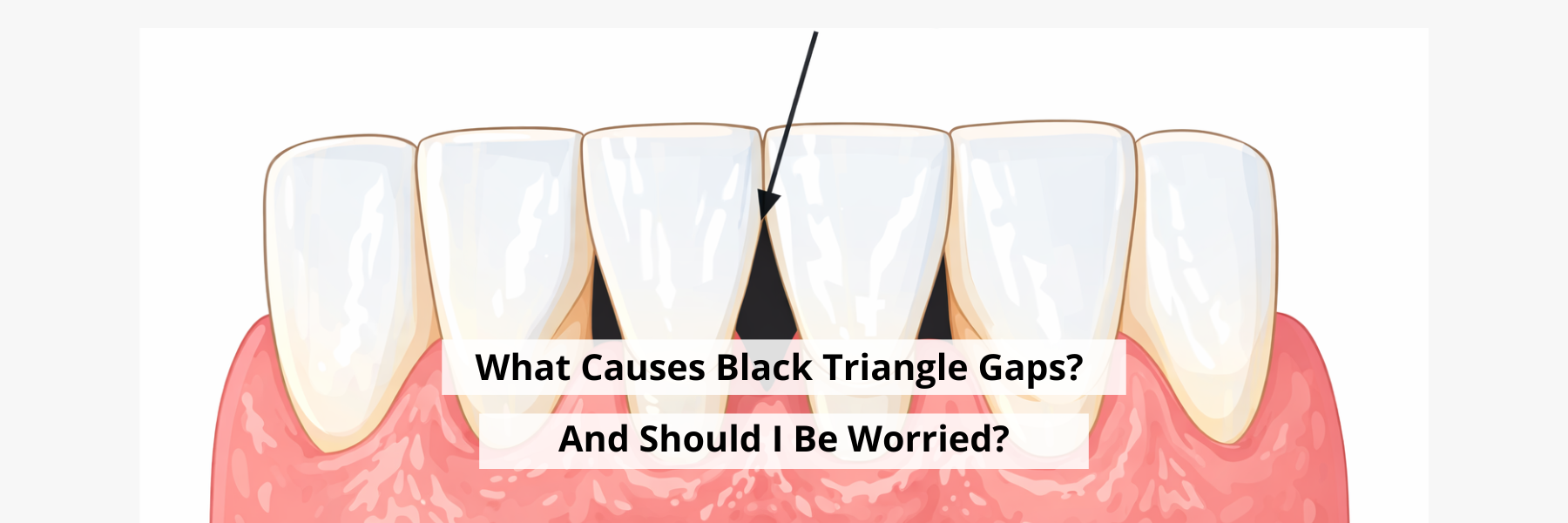
Noticed small dark gaps near the gumline between your teeth, particularly the front ones? These are commonly referred to as black triangles (clinically known as open gingival embrasures).
They’re relatively common. While they’re not always a health concern on their own, they can be frustrating. Food may catch more easily, cleaning can feel more difficult, and for some people, they affect how confident they feel when smiling.
In this blog we break down what black triangles are, why they sometimes become more noticeable after treatment, what causes them, and the different ways they can be managed.
What Is a Black Triangle?
A black triangle is the visible space between two teeth, just below the point where they meet. It appears dark because the small wedge of gum tissue that normally fills that space, called the papilla, doesn’t fully occupy the area.
One of the most important factors influencing this is the level of bone support underneath the gum.
Research has shown that when the distance between the contact point of the teeth and the supporting bone is around 5 mm or less, the papilla is much more likely to fill the space. As this distance increases, the likelihood of a visible gap also increases. (ResearchGate)
Why Black Triangles Can Appear After Gum Treatment
This is one of the most common and understandable concerns.
It can feel like treatment has caused the gap. In most cases, what’s actually happening is that treatment has revealed a space that was previously hidden.
When gums are inflamed, they often appear swollen and can temporarily fill these spaces. After periodontal treatment, inflammation reduces and the tissues return to a healthier, tighter position. If there has already been some bone loss, the gum may sit slightly lower than before, making the triangle more visible. (ResearchGate)
Treating gum disease is still important. Without it, inflammation and bone loss can continue, leading to more significant changes over time. Stabilising gum health helps protect the long-term foundation of the teeth.
There is also growing evidence linking periodontal disease with broader health conditions, particularly diabetes and cardiovascular disease. (Cochrane)
Other Common Causes of Black Triangles
Black triangles rarely have a single cause. More often, they develop due to a combination of factors.
Gum disease and bone loss can reduce the structural support that helps the papilla fill the space. Tooth shape also plays a role. Teeth that are narrower near the gumline tend to have higher contact points, leaving more room underneath.
Orthodontic treatment, including braces and clear aligners such as Invisalign®, can also contribute. As teeth move, the contact points between them shift, which can change how the gum tissue sits. (Europe PMC, aligntech.com)
Some people are naturally more prone to gum recession, particularly if they have thinner gum tissue or brushing habits that apply more pressure. In other cases, dental work such as fillings or crowns can alter how teeth contact each other, influencing the shape of the space between them.
Are Black Triangles Only a Cosmetic Issue?
For some people, the concern is mainly aesthetic, especially when the gaps are visible in the front teeth. That’s a valid consideration.
For others, the impact is more functional.
Spaces between teeth can make it easier for food to become trapped and for plaque to accumulate. This can lead to repeated irritation in the same area, making cleaning more technique-sensitive and sometimes less comfortable.
Interdental cleaning plays an important role here. A Cochrane review has shown that adding cleaning between the teeth to regular brushing can help reduce plaque and gingivitis. (discovery.dundee.ac.uk)
In larger gaps, some people may also notice subtle changes in airflow during speech.
When Does Treatment Make Sense?
Treatment is usually considered when black triangles are affecting either appearance, function, or both.
A common approach is to first stabilise gum health, then reassess once the tissues have settled. From there, the goal is to choose the most conservative option that creates a smooth, cleansable result.
Treatment Options: From Simple to More Involved
In some cases, no treatment beyond optimising home care is needed. Using the correct size interdental brush, refining technique, and maintaining regular dental visits can be enough to manage smaller gaps comfortably
When tooth position is a contributing factor, orthodontic treatment may help improve how teeth align and where they contact. In certain situations, a very small amount of enamel reshaping between teeth, known as IPR, may be used to create a broader contact area lower down. This is carefully planned and kept within safe limits. (Europe PMC)
For many patients, composite bonding is a practical and conservative option. This involves adding tooth-coloured material to reshape the contact area and reduce the appearance of the gap.
One approach uses an injection-moulding technique with the Bioclear matrix system. A randomised clinical trial comparing this method with a conventional matrix approach found both to be effective overall, with some advantages in marginal adaptation for the Bioclear technique. Aesthetic outcomes and gum response were broadly similar. (Springer Link)
At Mentone Family, the Bioclear matrix system is used in suitable cases with the aim of achieving a smooth, well-sealed, and cleansable result. (Bioclear)
It’s important to understand the limitations. Not all black triangles can be closed completely without affecting the natural proportions of the teeth, particularly where there has been significant bone loss. Composite can also change over time, including minor staining or wear, although it can usually be repaired if needed.
Other options may include soft tissue approaches such as hyaluronic acid fillers or surgical techniques in selected cases. Outcomes can vary depending on the situation, and long-term predictability differs between patients.
In some cases, a combination approach provides the most natural result. This might involve orthodontic alignment, conservative reshaping, and small amounts of bonding. By sharing the correction across multiple steps, it can reduce the risk of teeth appearing too wide.
What About Laser-Assisted Gum Treatment?
Laser-assisted periodontal treatment is sometimes used as part of managing gum disease, particularly for improving access, decontamination, and healing in selected cases. Outcomes vary depending on the technique, equipment, and individual circumstances. (Cochrane)
Even with these approaches, the appearance of black triangles is still largely influenced by bone support and tooth shape. (ResearchGate)
In other words, while gum health may improve, the presence of a visible gap may still remain.
The Bottom Line
Black triangles are common and often the result of underlying changes in gum health, bone support, or tooth position.
They’re not always something that needs to be “fixed”, but if they’re affecting how your teeth feel or how you feel about your smile, there are options available.
The most important step is understanding the cause. From there, treatment can be tailored to balance aesthetics, function, and long-term oral health.
This information is general in nature and doesn’t replace an individual assessment. The most suitable approach depends on factors such as gum health, bone support, tooth shape, and personal goals.